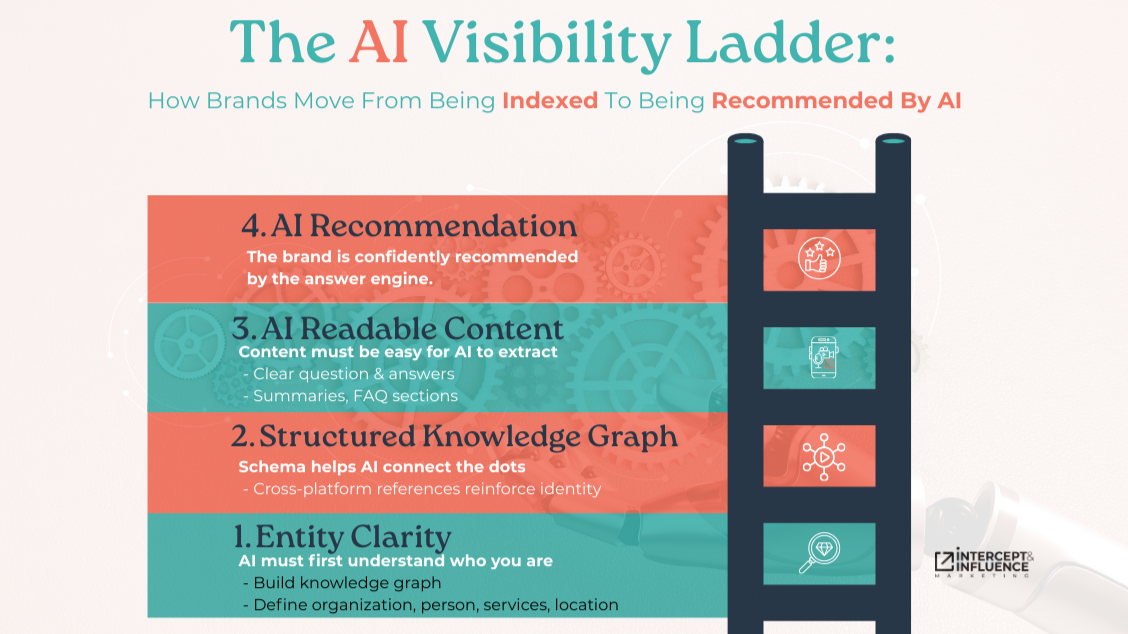
"A customer who never visits your website may still decide to buy from you because an AI system recommended your company, repeated your key claims, and supported those claims with credible evidence. That is brand distribution, not website traffic."
For more than twenty years, digital marketing operated on a simple model: create content, rank in Google, earn the click, convert the visitor. That model is disappearing. Publishers are reporting significant declines in search traffic as Google increasingly answers questions directly with AI-generated responses instead of sending users to websites. At the same time, AI assistants like ChatGPT, Claude, Gemini, and Perplexity are becoming destinations in their own right. Most discussions about this change focus on traffic. That is understandable, but it is also shortsighted. The more important change is that AI is becoming a new distribution layer for brands.
The Click Is No Longer the Product
Historically, Google acted as a directory. It pointed people toward websites. Today, AI increasingly acts as an interpreter. Instead of returning ten links, it returns an answer. Your brand may be part of that answer, or it may not. Either way, the customer often receives what they need without ever visiting your website. Publishers are increasingly adapting their content strategies for AI systems rather than relying solely on referral traffic, because the economics of search are changing.
A Fundamental Shift in Thinking
Many organisations are still asking: 'How do we get more AI traffic?' That may soon become the wrong question. A better question is: 'How is AI representing our brand?' Those are very different problems. Traffic measures visits. Representation measures influence. A customer who never visits your website may still decide to buy from you because an AI system recommended your company, repeated your key claims, and supported those claims with credible evidence. That is brand distribution, not website traffic.
AI Is Becoming a Brand Distribution Platform
Consider how a prospective customer now researches a purchase. Instead of opening ten browser tabs, they ask: 'Who are the best executive coaching firms?' or 'Which CRM should a mid-sized software company choose?' The AI synthesises thousands of documents into a single recommendation. In that moment, AI is not behaving like a search engine. It is behaving like a media channel, selecting which brands deserve attention and which narratives deserve repetition.
Why This Matters
Traditional SEO optimised webpages. AI optimisation increasingly influences perceptions. The questions brands need to answer are changing. Instead of asking 'Did we rank?', they are asking: Were we recommended? Which claims did AI repeat? What evidence supported those claims? Which competitors were positioned beside us? Those are fundamentally different measurement problems, and they require fundamentally different tools.
The New Scorecard
For years, marketers measured success through impressions, clicks, and conversions. In an AI-first world, those metrics remain important, but they are no longer sufficient. Brands also need to understand how they are represented inside AI systems during real customer decision-making. The companies that adapt first will not simply generate more traffic. They will become the brands AI consistently recommends, explains, and reinforces. And in the next era of digital marketing, that may be the distribution channel that matters most.
AEO Updates Takeaway
The biggest disruption is not that AI is reducing website traffic. It is that AI is becoming a new layer of brand distribution. The organisations that continue measuring only clicks may miss the more important question: how is AI representing your brand when customers are making decisions?
AEO Updates is published by The Prompt Group. Editorial decisions sit with the AEO Updates team, and any commercial relationship that touches a story is labelled on the page.